Introduction
Sending the same message to every contact stopped working years ago. Today's consumers expect communications that reflect what they actually care about — their recent behavior, preferences, and intent — not a one-size-fits-all blast.
Traditional rule-based segmentation can't keep up. Static demographic filters and manual list management were designed for a slower, simpler data environment. They miss non-obvious patterns, can't process behavioral signals in real time, and demand constant manual upkeep.
AI-driven segmentation platforms solve this by continuously analyzing behavioral, transactional, and engagement data to update audience segments automatically. They score customers by purchase likelihood, churn risk, and lifetime value — no manual intervention required.
The business case is clear: McKinsey's 2025 personalization research shows that moving from mass discounts to targeted promotions can lift total sales 1–2% and margins 1–3%, with generative AI-enhanced campaigns driving a 10% increase in customer engagement.
This guide covers the top AI audience segmentation platforms for 2026, what to look for when evaluating them, and how the same segmentation principles are reshaping internal communication — including how organizations listen to and engage their own employees.
Key Takeaways
- AI segmentation replaces static lists with dynamic, real-time segments built on behavioral and predictive data
- Top platforms for 2026 include Insider One, Salesforce Marketing Cloud, HubSpot, Klaviyo, and BlueConic
- Platform selection must match your team's technical maturity, existing stack, and business scale
- Privacy compliance — GDPR, CCPA, and consent management — is now a hard requirement
- Segmentation logic applies internally too: AnonyMoose lets organizations gather anonymous employee feedback across workforce segments
What Is AI Audience Segmentation and Why It Matters in 2026
From Static Filters to Dynamic Intelligence
Audience segmentation has traditionally relied on four types of data:
- Demographic — age, income, education, family size
- Geographic — location, climate, urban/rural proximity
- Psychographic — interests, values, attitudes, personality
- Behavioral — purchase history, browsing patterns, engagement frequency
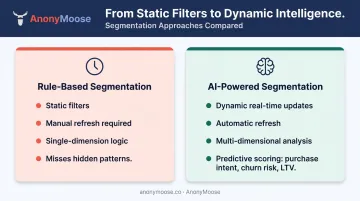
Rule-based segmentation uses these dimensions to create fixed filters: "customers over 35 in California who bought in the last 90 days." Useful, but limited. The segment doesn't update until someone manually refreshes it, and it can't surface patterns humans wouldn't think to look for.
AI-powered platforms change the mechanics. Machine learning models analyze all four dimensions simultaneously, update segments as user behavior changes in real time, and generate predictive scores — purchase likelihood, churn probability, expected lifetime value — automatically. The result is segmentation that reflects what customers are doing right now, not what they did last quarter.
The 2026 Shift: Warehouse-Native and Agentic Segmentation
Two structural changes define how platforms handle data in 2026:
- Warehouse-native activation — platforms segment and activate customer data directly from cloud warehouses like Databricks or Snowflake using zero-copy models, eliminating data duplication, pipeline lag, and stale segments
- Agentic marketing — AI agents that don't just build segments but take autonomous action on them, deciding the right channel, message, and timing without manual campaign setup
According to Twilio Segment's 2024 State of Personalization Report, 86% of business leaders expect a major shift from reactive to predictive personalization — but 61% worry inaccurate data will compromise their AI and ML efforts. That gap between ambition and execution makes data quality a competitive differentiator, not just an operational concern.
Segmentation Isn't Just for Customers
The same segmentation logic that drives customer intelligence is increasingly being applied inside organizations. Understanding how different workforce segments — by role, department, tenure, location — experience the workplace is as critical as understanding how customers behave.
AnonyMoose is designed specifically for this use case. The platform enables HR and leadership teams to collect anonymous feedback across precisely defined employee segments through four channels: Openlines, Polls & Surveys, Broadcast, and Hotlines.
Organizations can target specific subgroups using up to five custom criteria drawn from HRMS data — for example, all women managers in a specific city with more than ten years of tenure — while maintaining technical anonymity that ensures no individual response can ever be traced back to a specific employee.
Top AI Audience Segmentation Platforms for 2026
These platforms were evaluated on predictive accuracy, real-time segmentation capability, omnichannel support, integration breadth, and suitability across business sizes.
Insider One
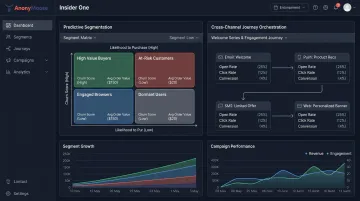
Insider One is a unified cross-channel marketing platform combining a customer data platform with predictive segmentation and journey orchestration. It's built for mid-market and enterprise brands running campaigns across web, mobile, email, and messaging channels from a single connected environment.
Insider's AI continuously analyzes behavioral and engagement signals across all touchpoints, generating predictive scores for purchase likelihood and churn risk while recommending next-best actions — without requiring multiple disconnected tools.
The platform supports 120+ rules and attributes and 20+ recommendation strategies. Customer outcomes cited on its platform page include a 259% AOV increase, 6x ROI, and 35% conversion rate increase for named examples.
Gartner Peer Insights rates Insider One at 4.9 out of 5 across 532 ratings, and G2 ranks it the #1 Leader across 11 categories.
| Feature | Detail |
|---|---|
| Key Features | Predictive segmentation, real-time dynamic segments, cross-channel journey orchestration, AI next-best-action, unified customer profiles |
| Best For | Enterprise and mid-market brands seeking hyper-personalized omnichannel campaigns without complex multi-tool workflows |
| Pricing | Custom pricing — contact Insider One directly for a quote |
Salesforce Marketing Cloud (Einstein)
Salesforce Marketing Cloud is an enterprise platform using Einstein AI to deliver predictive segmentation, dynamic audience updates, and omnichannel campaign orchestration, tightly integrated with Salesforce CRM as a unified customer data source.
Einstein evaluates historical data, engagement patterns, and predictive scores to automatically build and refresh segments, recommends optimal channels and send times, and handles the complex multi-system architectures large enterprise teams require. Salesforce has been named a Leader in the Gartner Magic Quadrant for Multichannel Marketing Hubs for seven consecutive years, and its Marketing Cloud Next positioning frames it as an agentic marketing platform.
| Feature | Detail |
|---|---|
| Key Features | Einstein AI segmentation, dynamic real-time audience updates, CRM-native data unification, advanced analytics and attribution, omnichannel campaign management |
| Best For | Large enterprises requiring advanced AI segmentation tightly coupled with full CRM data and multi-system integrations |
| Pricing | Marketing Cloud Next Growth at $1,500/org/month; Marketing Cloud Next Advanced at $3,250/org/month; Personalization at $8,000/org/month (all billed annually) |
HubSpot Marketing Hub
HubSpot Marketing Hub combines CRM, marketing automation, and AI-powered segmentation into a single platform designed to align marketing, sales, and service teams, with a user experience accessible to non-technical marketers.
HubSpot uses CRM data, lifecycle stage signals, and AI-powered contact scoring to build smart segments that automatically trigger personalized campaigns. Its AI assistant (Breeze) can generate segment filters and descriptions directly.
Predictive lead scoring estimates the probability that open contacts will close as customers within 90 days, and AI lead scoring is available to Enterprise users with as few as 50 contacts. HubSpot was named a Leader in the inaugural Forrester Wave for B2B Revenue Marketing Platforms in 2024.
| Feature | Detail |
|---|---|
| Key Features | Smart lists with behavior-based filtering, AI-powered contact and lead scoring, automated workflow triggers, unified CRM and marketing data, lifecycle stage segmentation |
| Best For | SMBs and mid-market teams that want CRM-aligned segmentation with marketing automation in one user-friendly platform |
| Pricing | Tiered (Starter, Professional, Enterprise) — visit HubSpot's pricing page for current rates |
Klaviyo
Klaviyo is a marketing automation platform built specifically for ecommerce brands. Its predictive analytics and AI-powered segmentation are designed to improve customer lifetime value, reduce churn, and maximize revenue from email and SMS campaigns.
Klaviyo analyzes purchase history, browsing behavior, and engagement signals to predict future actions, including churn probability, repeat purchase likelihood, and expected order dates. Jenni Kayne grew total email revenue 14.5% year-over-year using interest-based campaigns and purchase history segmentation.
Huda Beauty doubled Klaviyo-attributed revenue after overhauling list segmentation to improve deliverability. Gartner Peer Insights rates Klaviyo at 4.6 from 142 validated reviews.
| Feature | Detail |
|---|---|
| Key Features | Predictive CLV, churn, and purchase likelihood scoring; AI-driven email and SMS segmentation; ecommerce integrations; automated campaign triggers; A/B testing |
| Best For | B2C ecommerce brands seeking predictive segmentation that translates directly into measurable email and SMS revenue |
| Pricing | Free plan available under 250 active profiles; paid tiers scale by active profiles and sending volume — see Klaviyo's pricing page |
BlueConic
BlueConic is a customer data platform built specifically to unify first- and zero-party customer data into real-time profiles that power multi-dimensional audience segmentation, with a strong focus on privacy compliance, marketer self-sufficiency, and cross-channel activation.
Marketers can build segments using demographic, behavioral, and predictive dimensions simultaneously, with segments updating automatically as profiles evolve. BlueConic's zero-party data collection tools (quizzes, preference centers) produce consented, high-quality segmentation inputs that are increasingly valuable as privacy regulations tighten.
Over 150 integrations enable instant activation across existing MarTech stacks without IT involvement. Gartner Peer Insights rates BlueConic CDP at 4.2 from 70 ratings.
| Feature | Detail |
|---|---|
| Key Features | Multi-dimensional real-time segmentation, zero-party data collection, predictive and behavioral insights, 150+ integrations, instant cross-channel activation, no-IT segment building |
| Best For | Marketing and data teams seeking CDP-native segmentation with strong privacy compliance and direct activation across their existing MarTech stack |
| Pricing | Custom enterprise pricing — contact BlueConic directly |
Key Features to Look for in AI Audience Segmentation Platforms
Three Non-Negotiable Technical Capabilities
Before evaluating vendors, confirm these three capabilities are present — not roadmapped, not add-ons:
- Real-time dynamic segment updates — stale audience data wastes ad budget and erodes campaign relevance. Segments must refresh automatically as user behavior shifts
- Predictive scoring by purchase intent, churn risk, or lifetime value lets you act before users disengage rather than responding after the fact
- Unified customer data across web, mobile, CRM, and offline channels — platforms that can't consolidate these sources produce incomplete segments that hurt personalization accuracy
Only 1 in 4 marketers are satisfied with how they use data to power personalized moments, according to Salesforce's Tenth Edition State of Marketing report — which means most teams are still fighting a data activation problem, not just a campaign tool problem.
Omnichannel Activation and Integration Depth
Segmentation only creates value when those segments reach your email tool, ad network, and CRM automatically. A platform that requires manual exports erases most of the efficiency gains. Check for:
- Number of native integrations (BlueConic's 150+ is a useful benchmark)
- Warehouse-native connectivity for organizations running Snowflake, Databricks, or BigQuery
- Bidirectional sync with CRM data for sales-aligned segmentation
Privacy and Compliance in 2026
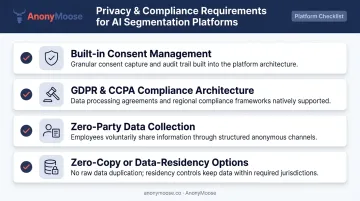
California issued its first CCPA fine in March 2025, and enforcement is accelerating globally. Data governance is now a platform selection criterion, not an afterthought.
Look for:
- Built-in consent management
- GDPR and CCPA compliance architecture
- Zero-party data collection capabilities (customer-volunteered information)
- Zero-copy or data-residency options for organizations with strict localization requirements
How to Choose the Right Platform
Five Evaluation Criteria
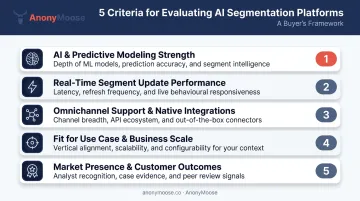
The platforms in this guide were assessed on:
- AI and predictive modeling strength — depth of scoring models, not just basic filtering
- Real-time segment update performance — how quickly segments reflect new behavioral data
- Omnichannel support and native integrations — breadth of activation channels and connector library
- Fit for stated use case and business scale — enterprise CDP vs. accessible SMB automation are different products
- Market presence and documented customer outcomes — third-party validation, not just vendor claims
The most common buyer mistake is choosing based on brand recognition rather than fit. An enterprise tool with sophisticated warehouse-native capabilities (built to run directly on your data warehouse) won't justify the cost for a lean SMB marketing team — it adds complexity without the returns.
Before You Commit
- Run a trial or demo with your actual data — not a vendor-curated demo environment
- Evaluate onboarding and support quality — implementation quality often determines whether a platform delivers its promised outcomes
- Assess migration risk — enterprise SaaS contracts are long; understand how difficult it is to move your data if needs change
Conclusion
The AI audience segmentation landscape in 2026 offers genuine options for every business size. Klaviyo and HubSpot provide accessible, powerful segmentation with transparent pricing for SMBs and mid-market teams. Insider One, Salesforce Marketing Cloud, and BlueConic serve enterprise and mid-market brands that need deeper predictive capability, warehouse connectivity, or CDP-native data unification.
The right choice is the one that aligns with your actual marketing objectives, existing technology stack, and data maturity, not the one with the most impressive demo.
And the same segmentation thinking applies internally. Organizations that invest in understanding their external audiences but ignore internal workforce segments are missing a significant source of intelligence.
AnonyMoose gives HR and leadership teams the ability to listen to precisely defined employee segments — by department, role, tenure, location, or any custom attribute — through anonymous polls, surveys, Openlines, and Hotlines. Every employee group's voice can shape leadership decisions, without fear of retaliation. If workplace culture is a priority, explore AnonyMoose to see how it works in practice.
Frequently Asked Questions
What are the four levels of audience segmentation?
The four primary types are demographic (who people are), geographic (where they are), psychographic (why they behave as they do), and behavioral (how they actually act). AI platforms can apply all four simultaneously using unified customer data, rather than forcing marketers to choose one dimension at a time.
Which method is most effective for audience segmentation?
Behavioral segmentation is widely considered the most actionable because it's grounded in what customers actually do — purchase history, browsing patterns, engagement frequency. AI platforms make it far more effective by continuously updating behavioral segments in real time as new signals arrive.
What is the difference between rule-based and AI-powered segmentation?
Rule-based segmentation groups audiences using predefined filters (for example, "customers who purchased in the last 30 days"). AI-powered segmentation goes further, using machine learning to discover non-obvious patterns, predict future behavior, and automatically refresh segments as data changes — eliminating manual list management entirely.
Can small businesses benefit from AI audience segmentation?
Yes. Platforms like HubSpot and Klaviyo are specifically designed with SMBs in mind, offering accessible AI segmentation features — including predictive scoring and automated behavioral triggers — without requiring a dedicated data science team or large technical infrastructure.
How do AI segmentation tools handle data privacy and compliance?
Leading platforms build consent management directly into their architecture, support GDPR and CCPA requirements, and increasingly offer zero-party data collection that relies on customer-volunteered information. This reduces regulatory exposure while producing higher-quality segmentation data. Both factors carry more weight with every new enforcement cycle.